With the state’s 2026 spring legislative session now behind us, it’s time to celebrate the key victories that we achieved.
Each of these legislative successes will mean important changes to state law that will make it safer and easier to walk, bike, and use transit.
We’re especially grateful for the thousands of Active Transportation Alliance members and supporters who responded to our calls to action over the past several months. Your voices are powerful and directly responsible for the progress this session.
Of course, not every priority advanced and not every final bill was perfect. Much more work remains to be done on these policies and others.
But as we work towards a better future for walking, biking, and transit, it’s important to take a moment to applaud our collective progress!
Here are a few highlights from this legislative session:
STOP SUPER SPEEDERS—HB 4948
Research shows that a small number of “super speeders” are responsible for a disproportionately large share of deadly crashes. These drivers are several times more likely than typical motorists to be involved in deadly collisions, and traditional enforcement—such as license suspension—has proven largely ineffective. Nationally, 75 percent of drivers with a suspended license continue to drive illegally in order to meet their needs.
This legislation lays the groundwork for use of Intelligent Speed Assistance (ISA) technology, which uses GPS and onboard sensors to prevent the most dangerous drivers from exceeding posted speed limits. Participating in the ISA program allows them to maintain their mobility safely and legally, without being forced to choose between breaking the law and keeping their job.
- The program will be administered by the Secretary of State.
- People whose driver’s license has been suspended due to convictions of driving 26 miles per hour or more over the speed limit twice in a 12-month period are eligible for the program.
- Participants will be issued a restricted driving permit that allows them to drive only vehicles equipped with the ISA device.
We are so thankful for our partnership with Families for Safe Streets on this policy and special thanks to Representative Marti Deuter and Senator Julie Morrison for their leadership on this new safety tool.
MICROMOBILITY SAFETY–SB 3484
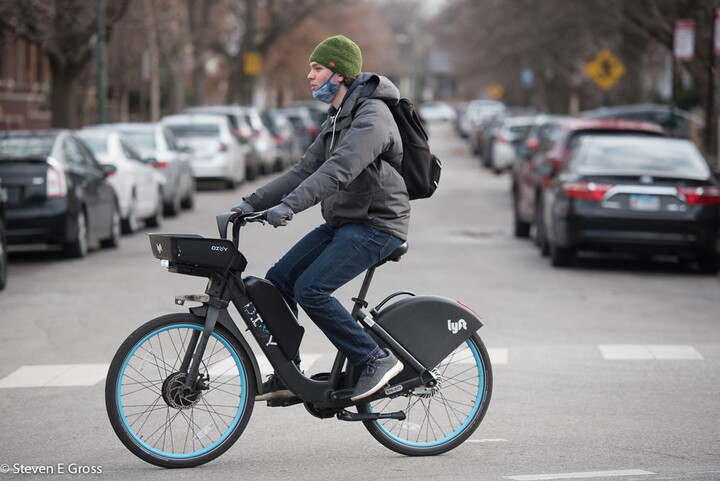
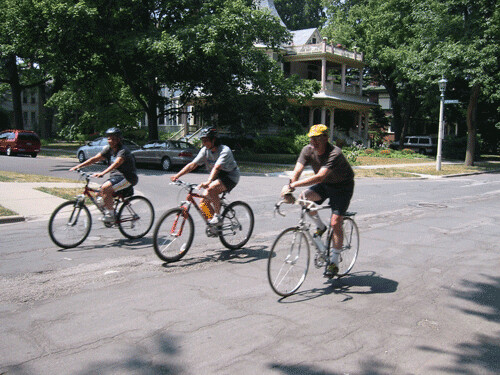
Electric mobility devices such as e-scooters, e-motos, electric skateboards, and electric unicycles—collectively known as “micromobility”—will be subject to stronger safety regulations under newly passed legislation.
As more and more powerful micromobility devices have been entering the market, there’s been a clear gap in existing policy, which provided for the regulation of low-speed e-bikes, but not the large number of newer, more powerful devices capable of traveling at speeds greater than 28 mph.
Many local municipalities attempted to address this gap in regulation by passing a myriad of different local ordinances, leading to a confusing patchwork across jurisdictions that was difficult to navigate for people crossing community boundaries and some communities ended up banning e-bikes outright.
Led by the Illinois Secretary of State Alexi Giannoulias and team, with input from a host of stakeholders including Active Transportation Alliance and Ride Illinois, this legislation creates a new system for classifying previously unregulated, high-powered micromobility devices and associated regulations, such as licensing and insurance requirements for the fastest, most powerful devices and clarifying where these devices can be operated.
- Devices that have a motor over 750 watts and speed capability over 28 mph are not classified as bicycles in the vehicle code—they are motor driven cycles and as such operators must have a valid driver’s license, title, registration, and insurance. These often look like bikes but are much faster and more powerful and are not allowed in bike lanes or on paths.
- Prohibits any retailer, distributor, or manufacturer from marketing, advertising, labeling, or otherwise offering for sale any motor-driven cycle that would cause a consumer to believe that it is a low-speed electric bicycle.
- People who ride electric scooters and electric skateboards must be 16 or older, Class 1 and 2 e-bikes must be 15 or older, and for Class 3 e-bike (higher speed/pedal assist over 28 mph) must be 16 or older (current law).
- For pedestrian safety, e‑bikes and e-scooters are not allowed on sidewalks.
- Provides for exceptions for adaptive devices.
We are grateful for our partnership with Ride Illinois and the Illinois Secretary of State on this policy and bill sponsors Representative Barbara Hernandez and Senator Ram Villivalam for setting this safety foundation set for emerging personal mobility options.
STATE SPEED LIMIT REFORM—HB 5081
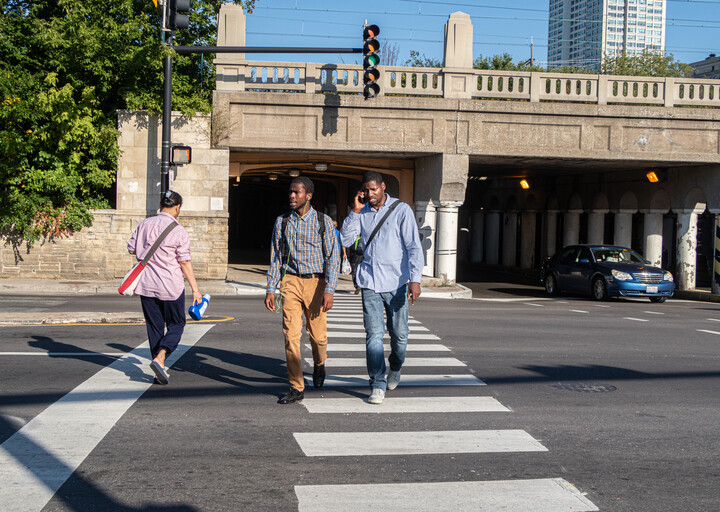
Unsafe speeds play a major role in serious injuries and fatal crashes on our roadways. The ways we manage speed needs to be improved—from road design, to default speed limits on streets in urban areas (e.g. towns, cities) and on residential streets, and the hurdles communities need to jump through to lower speed limits.
For example, even when a local community wanted to lower the speed limit, it can only do so on roadways it controls, and would have to pay for a costly traffic study to justify safer speeds. This amounted to a barrier to safer speeds for communities across Illinois.
The new legislation starts to address these hurdles.
- Communities can now set lower speed limit maximums by ordinance without a traffic study:
-
- 20 mph or 25 mph on roads in an urban district
- 20 mph maximum on roads in a residence district
- 10 mph maximum in an alley
- The legislation also makes it easier for communities to work with IDOT to lower the speed limit on state-controlled roads
- The legislation introduces a target speed framework for establishing speed limits which embeds in our policies context about what kind of street we want, and who it should serve safely—safety for all road users is embedded in the process.
These new policies are a big step forward, but we have more work to do make lower speeds widespread, to design our streets for safe travel, especially for people walking and biking, and to fix our speed camera policies.
We are appreciative of Representative Matt Hansen, Senator Mike Porfirio and IDOT for taking this important policy on and for working with us on ways to strengthen it.
FINE TUNING THE NORTHERN ILLINOIS TRANSIT AUTHORITY ACT—HB 2335
The scale of last fall’s transit funding and reform victory cannot be overstated. As such, there are inevitably legislative details that require fine tuning and refinement as part of the General Assembly’s normal workflow.
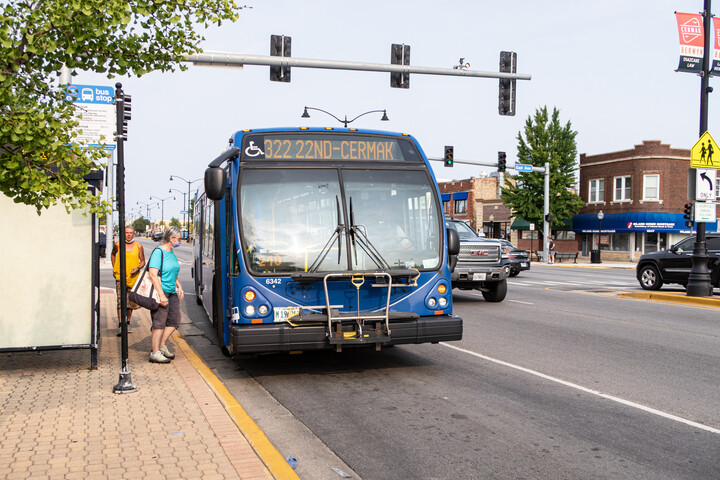
HB 2335 adds clarity to the funding distributions, consistency for board appointments, some updated timelines, and some needed definitions. Legislators have been working throughout the spring session to make these adjustments in time for the NITA legislation to take effect on June 1.
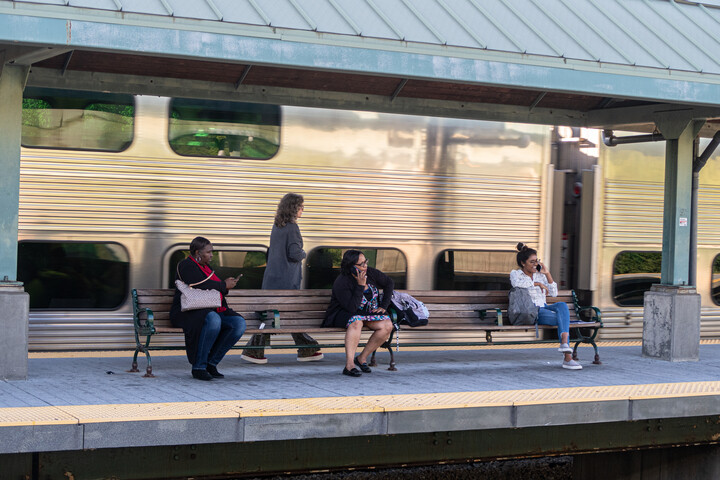
All the state funding needed for NITA in the coming year was included in the state budget that passed and this morning the Regional Transportation Authority passed the final revenue piece. So NITA is up and running, fully funded. Let’s get rolling!!
We are still unpacking what was in the final approved budget as it relates to transit, walking, and biking and will share more soon.
We are grateful to all of you for taking action and to our elected leaders for doubling down on safety. Looking forward to seeing you walking and biking and rolling!