Riding your bike through town, you feel invisible to drivers. You’re worried about children crossing the street with distracted drivers in super-sized SUVs.
Yet your suburb has done little to improve safety for people walking and biking.
While cities like Chicago and Evanston are building miles of protected bike lanes, getting even a single bike lane in your town seems like a stretch at best.
Change in a small suburb takes persistence, but it’s possible.
You don’t need money. You don’t need to be a city planner. You don’t need many people. You don’t even need to be an avid bicyclist.
Just a handful of concerned residents will do.
In less than two years of organizing rides and engaging local residents and lawmakers, the Village of Riverside — a village of 9,000, nine miles west of downtown Chicago — responded. Riverside’s first Bike and Pedestrian Plan is now in development.
The following approach is what made that progress possible.
BUILD A COMMUNITY BEFORE YOU BUILD INFRASTRUCTURE
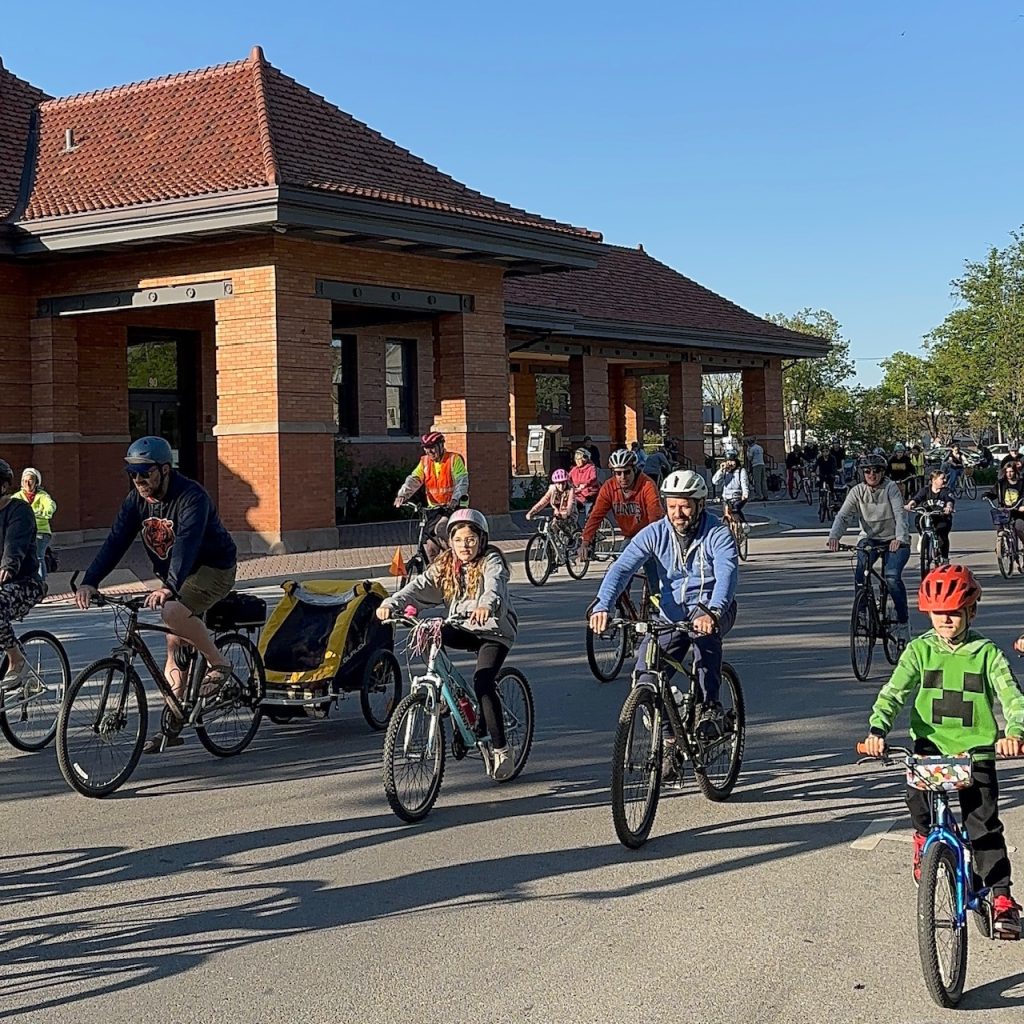
We started by organizing monthly community rides, which we call “Slow Rolls.” We chose a consistent time and a visible location, starting near the train station.
Our goal was to design these rides for people who don’t see themselves as “cyclists.”
Routes should be short (4-5 miles), slow (6-7 mph), and intentionally avoid stressful crossings.
By incorporating themes and collaborating with local businesses, we aim to make the rides feel like community events, where biking isn’t the only focus.
Once the ride attendance gets big enough, your town’s decision-makers will notice.
If biking feels like a fringe activity, it will be treated that way. If it feels social and normal, it becomes part of the town.
We now have nearly 100 riders most months of the year. That means one percent of our population is present at most of our rides.
The goal isn’t the ride; it’s about normalization.
TAKE FEAR SERIOUSLY
We don’t assume people aren’t biking because they lack interest. Many are simply scared.
One close pass or cut-off at an intersection is enough to discourage the average person from biking on the street again, even on streets that most cyclists find manageable. If your early efforts don’t consider this, they will fail to attract new riders.
Routes, messaging, and events should all be designed to lower that barrier. When people feel safe enough, participation follows.
GET POLITICAL IN A SMALL-TOWN WAY
In a suburb, politics are local and personal. The decision-makers are your neighbors. Invite them to one of your Slow Rolls.
Start reading your town’s board meeting agenda packets, watch the meeting recordings, and get familiar with how decisions are made.
Introduce yourself. Ask questions. Find out what projects are already in progress.
Learn what matters to the leaders and how bicycling ties into those values. Turn concerns into specific, respectful questions.
It’s easy to dismiss an upset cyclist pounding his or her fist at a village board meeting, but it’s not easy to ignore a citizen calmly saying, “I’m afraid to let my child cross the street in front of his school. What is the village’s plan to improve safety for kids biking and walking to schools?”
DEVELOP A PERSONAL STORY TO TELL
Data matters, but stories have the power to move people.
For me, it all began after witnessing the aftermath of a crash involving a motorist and a child on a bike. That sparked a simple question: Is it truly safe to bike here?
This question prompted a review of Illinois Department of Transportation crash data, revealing a broader pattern.
Your story doesn’t have to be dramatic, but it must be genuine and personal.
MAKE A SPECIFIC ASK
After gaining community support and clarifying our story, we decided on our goals.
We created an online petition calling for a Vision Zero plan that would outline community strategies to eliminate traffic fatalities and serious injuries through a comprehensive approach to road safety.
What the village ultimately agreed to was creating a Bike and Pedestrian Plan, which will recommend specific infrastructure and policies to improve walking and biking.
While we didn’t get the original request, the outcome was just as meaningful. In practice, the exact request matters less than creating forward momentum.
CENTER CHILDREN IN THE CONVERSATION
Nothing shifts the focus of the issue more quickly than the question of whether children can safely get around town. It’s hard to argue against the safety of kids walking or biking to school.
This shifts the issue from what some people may see as a niche concern to one about public safety.
The historical example of Stop de Kindermoord (Stop Murdering Children) movement in the Netherlands demonstrates how powerful that framing can be.
Locally, it attracts parents, schools, and a wider base of support that extends beyond what is often perceived as a small group of cyclists. Safe routes to school can become a tangible, fundable project.
SMALL ACTIONS MATTER MORE IN SMALL SUBURBS
A handful of people focused on a particular issue at a public meeting in Chicago usually goes unnoticed.
In a small suburb, a handful of residents showing up with a petition is newsworthy, quite literally.
Likewise, a single traffic safety improvement in a large city can be invisible.
In a small suburb, one bike lane isn’t incremental: it’s transformational. From there, it becomes easier to build on that success.
Many feel discouraged about the slow progress for people walking and biking in car-focused suburbs, but our experience shows that change is possible.
Progress can be made through consistent engagement with the community and decision-makers. When that happens, what once seemed like a big ask becomes inevitable.
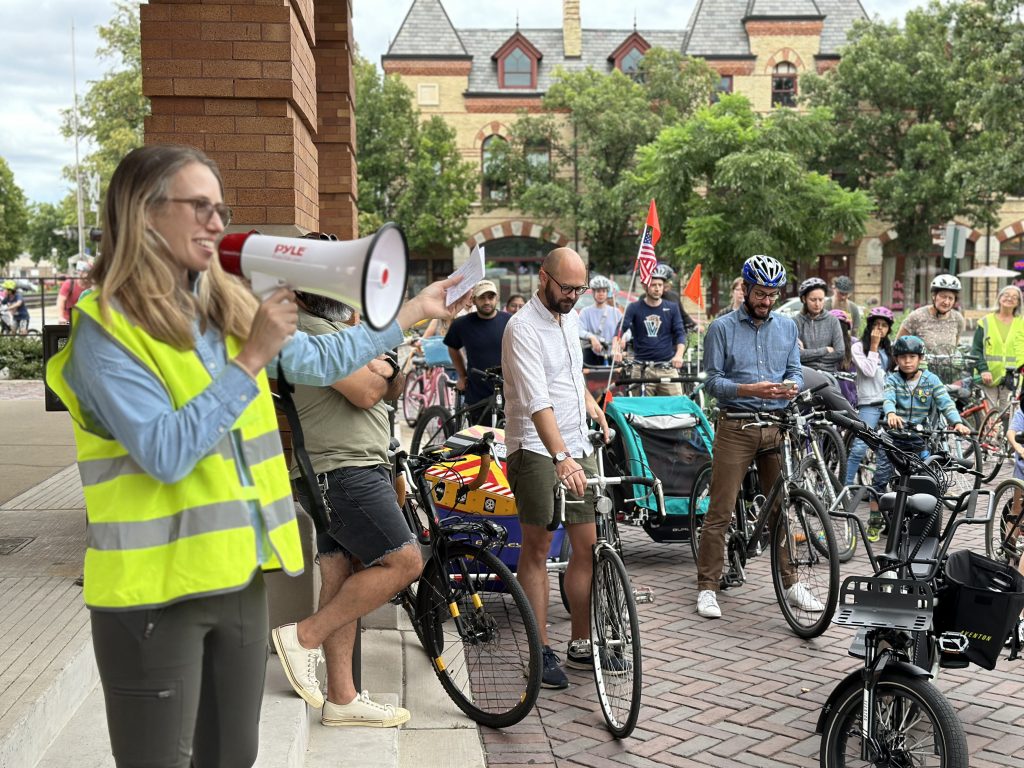
This post was written by Valerie Kramer (pictured, top), the founder of Ride Riverside and a 2025 winner of the Active Transportation Alliance Advocate of the Year award. She volunteers her time mentoring local active transportation groups. For inquiries, contact her at [email protected].
Photos courtesy of Valerie Kramer.